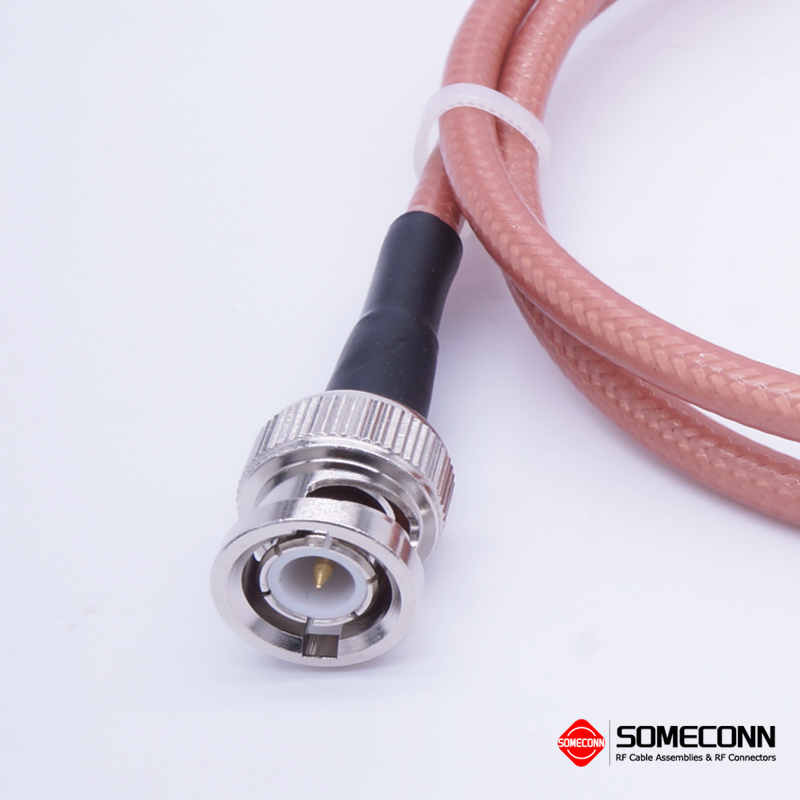
RG142 BNC Cable is a 50Ω coaxial cable assembly designed for professional RF and high-reliability electronic equipment. It is widely deployed in RF, microwave, communications, test & measurement, aerospace, military electronics, industrial electronics, GPS/GNSS, radar and laboratory instrumentation.
Compared with ordinary general-purpose coaxial cables, RG142 features these key attributes:
50Ω characteristic impedance
PTFE dielectric
Double shield
FEP outer jacket
Excellent high-temperature performance
Strong electromagnetic interference resistance
Superior mechanical reliability
Compatible with a wide range of RF connectors
A typical RG142 construction employs silver-plated copper-clad steel center conductor, PTFE dielectric, double silver-plated copper braid shield and FEP outer jacket. The M17/60-RG142 specification under MIL-DTL-17 remains active and serves as an important standard reference for RG142 products.
When RG142 coaxial cable is terminated with BNC connectors on both ends, it forms an RG142 BNC Cable Assembly, which can be used to interconnect:
RF test instruments
Communication equipment
Radar systems
GPS/GNSS devices
Avionics equipment
Military electronics
Laboratory instruments
RF modules
Antenna systems
If you require an RF Cable Assembly with stronger shielding, better temperature performance and higher reliability than standard RG58, RG142 is a worthy candidate.
This article comprehensively covers RG142 BNC Cable, including construction, specifications, applications, connector selection, differences between RG142 and RG58/RG316, advantages, limitations, OEM/ODM customization, manufacturing processes, quality control and procurement guidelines.
1. What is RG142 BNC Cable?
RG142 BNC Cable is an RF cable assembly built from RG142 coaxial cable terminated with BNC connectors on one or both ends.
RG142 is typically a 50Ω coaxial cable. The typical M17/60-RG142 construction has an outer diameter of approximately 0.195 inches, equivalent to around 4.95 mm.
A complete RG142 BNC Cable generally consists of:
Center conductor
PTFE dielectric
First shield layer
Second shield layer
FEP outer jacket
BNC connector
Optional heat-shrink tubing, boot, labels or protective structures
Based on customer equipment interfaces, RG142 can also be fabricated as:
BNC Male to BNC Male
BNC Male to BNC Female
BNC Female to BNC Female
BNC Male to SMA Male
BNC Male to SMA Female
BNC Male to TNC
BNC Male to N-Type
BNC combined with other RF connectors
2. Why Choose RG142 BNC Cable?
RG142 sits between ordinary general-purpose RF cables and high-performance professional RF cables; it is a classic professional-grade coaxial cable construction.
Its key characteristics:
50Ω impedance: Compatible with a large number of RF and communication systems.
Double shield: Delivers superior EMI protection compared with some single-shield cables.
PTFE dielectric: Offers excellent electrical and thermal performance.
FEP jacket: Provides good environmental and temperature adaptability.
High-temperature capability: Specific RG142 constructions can operate in elevated-temperature environments.
Robust mechanical structure: More durable than some ultra-miniature coaxial cables.
Broad RF connector compatibility: Can be assembled with BNC, SMA, TNC, N-Type and other connectors.
Therefore, RG142 is ideal for applications requiring high performance in: RF + High Temperature + EMI + Reliability
3. Internal Construction of RG142 Cable
The performance of RG142 is closely tied to its internal structure.
Center Conductor
Typical RG142 uses silver-plated copper-clad steel center conductor. This design combines the mechanical strength of the steel core with the conductivity of copper and silver plating.
The center conductor affects:
DC resistance
RF transmission
Signal loss
Mechanical strength
Temperature performance
Connector termination quality
Conductor construction varies by manufacturer; always refer to the actual datasheet for procurement.
4. PTFE Dielectric
RG142 normally uses solid PTFE as the dielectric layer. PTFE is a widely adopted material for high-temperature RF cables. It delivers excellent:
Insulation performance
Temperature resistance
Electrical stability
Chemical stability
The dielectric layer impacts:
Characteristic impedance
Capacitance
Propagation velocity
Attenuation
Temperature performance
The M17/60-RG142 standard explicitly specifies solid extruded PTFE dielectric.
5. RG142 Double Shield
One of the most distinctive features of RG142 is its Double Shield / Double Braid. Standard RG142 uses two layers of silver-plated copper braid shielding.
The double shield is designed to:
Reduce external EMI interference
Minimize RF leakage
Lower signal coupling
Improve system immunity to interference
This makes RG142 especially suitable for installation near:
Motors
Switchgear
High-current wiring
RF transmitting equipment
Inside industrial control devices
Inside high-density electronic assemblies
Note that actual shielding effectiveness depends on:
Braid coverage
Shield material
Operating frequency
Connector construction
Termination process
Installation method
6. FEP Outer Jacket
RG142 typically uses an FEP outer jacket. FEP is a fluoropolymer offering excellent:
Temperature performance
Chemical stability
Environmental resistance
Insulation properties
The typical M17/60-RG142 outer diameter is approximately 4.95 mm.
The outer jacket protects the internal components:
Center conductor
PTFE dielectric
Double shield against mechanical and environmental damage.
7. Typical Specifications of RG142 BNC Cable
RG142 specifications vary among manufacturers. Key parameters for the standard M17/60-RG142 construction:
| Parameter | Typical Value / Description |
| Product Type | RG142 / RG142 B/U |
| Impedance | 50Ω |
| Center Conductor | Silver-plated copper-clad steel |
| Dielectric | Solid PTFE |
| Shield | Double silver-plated copper braid |
| Jacket | FEP |
| Outer Diameter | Approx. 4.95 mm |
| Capacitance | Approx. 29 pF/ft |
| Velocity of Propagation | Approx. 69–70% |
| Operating Voltage | Subject to specific specification |
| Operating Temperature | Some constructions: -55°C ~ +200°C |
| Connectors | BNC / SMA / TNC / N-Type / Custom |
| Length | Customizable |
| Operating Frequency | Dependent on construction |
For example, the M17/60-RG142 specification defines 50Ω impedance, PTFE dielectric, double silver-plated copper braid, FEP jacket, maximum operating frequency of 12.4 GHz and operating temperature range of approximately -55°C to +200°C.
Please note: RG142 parameters differ by manufacturer. Some commercial RG142 products may list a lower maximum operating frequency or different electrical characteristics.
Therefore, when selling RG142, avoid oversimplified wording such as:
“All RG142 cables operate at the same frequency and temperature.”
A more professional statement:
“Specifications vary depending on cable construction and manufacturer. Please contact us for the detailed datasheet of the required RG142 cable.”
8. Major Applications of RG142 BNC Cable
RG142 BNC Cable covers a broad range of applications.
9. RF Test & Measurement
Test & measurement is a key application field for RG142 BNC Cable. Suitable for:
Signal Generator
Spectrum Analyzer
RF Analyzer
Oscilloscope
Network Analyzer
RF Test Fixture
Laboratory Equipment
Electronic Measurement Equipment
BNC connectors are widely used on test instruments. RG142 is preferred when test environments demand high performance in: EMI, temperature, RF stability and shielding.
10. Aerospace & Avionics
RG142 is commonly deployed in electronic systems requiring strict control of: Temperature, RF performance, EMI and reliability.
Typical applications:
Avionics
Aircraft communication systems
Navigation equipment
RF instruments
Aerospace test equipment
Electronic modules
Antenna interconnections
PTFE dielectric, double shield and FEP jacket make RG142 suitable for many professional electronic interconnection scenarios.
Aerospace projects usually require additional considerations: Qualification, material requirements, traceability, environmental testing, documentation and connector standards. Simply selecting “RG142” does not automatically satisfy all aerospace project requirements.
11. Military & Defense Electronics
RG142 has long been strongly associated with professional RF and military electronics.
Potential applications:
Military communication equipment
RF equipment
Radar-related systems
Electronic warfare equipment
RF test equipment
Navigation devices
Portable RF equipment
Defense instrumentation
M17/60-RG142 itself is one of the standard constructions for flexible 50Ω RF coaxial cable, supporting connector families including BNC, TNC and SMA.
For specific military projects, verify: Certifications, testing, traceability, materials, reliability and documentation according to project specifications.
12. Wireless Communication Equipment
RG142 BNC Cable can be used for internal RF signal interconnections inside wireless communication hardware.
Applications:
Wireless Communication Equipment
RF Module
Base Station Equipment
Communication Test Equipment
Antenna System
RF Development Platform
With its 50Ω construction, RG142 matches many 50Ω RF systems.
13. Radar & RF Systems
Radar and RF systems place heavy emphasis on: Signal integrity, shielding, impedance, return loss, insertion loss and connector performance.
RG142 can be applied to:
RF signal interconnections
Radar test equipment
RF modules
Antenna connections
Laboratory radar systems
RF test systems
Especially for high-frequency applications, the cable alone is not sufficient. Full RF performance depends on: Cable + Connector + Termination + Assembly Quality
Poor connector termination will degrade RF performance even with premium RG142 cable.
14. GPS/GNSS Applications
RG142 can also be used in GPS/GNSS systems.
Possible applications:
GPS receivers
GNSS receivers
Navigation equipment
Antenna connections
Positioning systems
RF test equipment
GPS applications require careful evaluation of: Operating frequency + cable length + attenuation + connector loss + system signal budget. Longer cables introduce greater signal loss.
15. Medical & Laboratory Equipment
Certain medical, scientific and laboratory instruments require high-shielding RF Cable Assemblies.
RG142 may be considered for:
Laboratory instruments
Scientific instruments
RF medical equipment
Detection devices
Monitoring systems
Measurement systems
Medical applications typically impose strict requirements for: Materials, cleanliness, chemical exposure, documentation and traceability. Customization is mandatory to match specific equipment specifications.
16. Industrial RF Equipment
RG142 is also suitable for selected industrial RF applications.
Examples:
Industrial RF equipment
RF sensors
Automation equipment
Electronic control systems
Measuring devices
RF monitoring systems
If the cable runs near: Motors, inverters, switching power supplies or high-current devices, the double shield delivers tangible benefits.
17. RG142 vs RG58 BNC Cable
Both RG142 and RG58 are 50Ω coaxial cables, but their constructions differ significantly.
| Characteristic | RG142 | RG58 |
| Impedance | 50Ω | 50Ω |
| Dielectric | PTFE | Typically PE |
| Shield | Double braid | Construction-dependent |
| Jacket | Usually FEP | PVC/PE etc. |
| Temperature Performance | Higher with proper construction | Generally lower |
| Outer Diameter | Typical ~4.95 mm | Typical ~5 mm |
| EMI Performance | Strong double shield | Construction-dependent |
| Cost | Generally higher | Generally lower |
| High-Temperature Use | More suitable | Construction-dependent |
| General RF Applications | Suitable | Very widely used |
Choose RG58 if priorities are low cost and general RF use. Choose RG142 for high-temperature environments, EMI protection, double shielding and demanding professional RF environments.
18. RG142 vs RG316 BNC Cable
RG142 and RG316 are both 50Ω RF cables but differ in size and construction.
| Characteristic | RG142 | RG316 |
| Impedance | 50Ω | 50Ω |
| Outer Diameter | ~4.95 mm | ~2.5–3 mm |
| Shield | Double braid | Construction-dependent |
| Dielectric | PTFE | Typically PTFE-based |
| Jacket | Usually FEP | Usually fluoropolymer-based |
| Flexibility | Good | Excellent |
| EMI Performance | Strong double shield | Construction-dependent |
| Mechanical Strength | Higher | More compact |
| Miniature Devices | Suitable | Highly suitable |
| High-Temperature Applications | Suitable for specific constructions | Suitable for specific constructions |
| Cost | Generally higher | Generally lower |
In short: RG316: Small, light, highly flexible. RG142: Double shield, mechanically robust, built for harsher environments. Final selection must follow actual application requirements.
19. RG142 BNC Connector Selection
RG142 can be fitted with various BNC connectors.
BNC Male For mating with BNC Female ports on equipment.
BNC Female For equipment interfaces and some panel-mount applications.
Right Angle BNC For space-constrained devices.
Bulkhead BNC Designed for feed-through or panel mounting.
BNC to SMA Ideal for connecting BNC test instruments to SMA-based RF modules.
BNC to TNC For systems with TNC interfaces.
BNC to N-Type For communications, antennas and RF equipment.
Connector selection requires comprehensive evaluation of: Impedance, frequency, interface, available space, mechanical strength and environment.
20. RG142 BNC Cable Length
RG142 can be customized to many lengths. Examples: 0.3 m, 0.5 m, 1 m, 1.5 m, 2 m, 3 m, 5 m and other custom lengths.
For RF systems: longer cables generally produce higher loss. For loss-sensitive applications, minimize unnecessary cable length. However, cables should not be made excessively short purely to reduce loss. Design should balance: RF loss + installation clearance + maintenance access.
21. RG142 for High-Temperature Applications
One major advantage of RG142 is its suitability for high-temperature environments. The M17/60-RG142 construction specifies a typical operating temperature range of: -55°C ~ +200°C
PTFE dielectric and FEP jacket together enable this high-temperature capability.
Typical use cases: Aerospace, military electronics, industrial RF equipment, high-temperature test fixtures, electronics near heat sources and laboratory instruments.
Important note: The temperature rating of the cable alone does not equal the temperature rating of the complete Cable Assembly. Full assembly performance also depends on: BNC connectors, SMA connectors, solder, crimping, heat-shrink tubing, boots and sealing materials.
22. Importance of RG142 Double Shield
The double shield is a key differentiator separating RG142 from many ordinary RF cables. Dual braid helps reduce: External EMI, RF leakage, electromagnetic coupling and crosstalk.
Actual shielding performance depends on: Braid coverage, material, operating frequency, connectors, termination process and installation method.
When purchasing RG142, do not only ask:
“Is it RG142?”
Also confirm:
“What is the actual shielding construction and termination method?”
For RF Cable Assemblies, connector termination quality is as critical as the cable itself.
23. How to Select RG142 BNC Cable?
1. Confirm Impedance RG142 is nominally 50Ω. Verify your equipment is also a 50Ω system.
2. Confirm Frequency Define the actual operating frequency. Attenuation typically rises at higher frequencies.
3. Confirm Length Longer cables normally introduce greater signal loss.
4. Confirm Temperature Verify the operating temperature rating for the entire Cable Assembly.
5. Confirm Shielding Determine whether Double Shield is required.
6. Confirm Connectors For example: BNC Male, BNC Female, Straight, Right Angle, Bulkhead, SMA, TNC, N-Type
7. Confirm Mechanical Requirements Including: Bend radius, repeated flexing, vibration, tensile load and installation space.
8. Confirm Operating Environment Including: Temperature, humidity, chemical exposure, oil, vibration, outdoor exposure and EMI.
24. RG142 BNC Cable Customization Service
Professional RF Cable Manufacturers can produce custom RG142 BNC Cable Assemblies per customer drawings and specifications.
Cable Length Custom lengths available.
Connector Combination Examples: BNC-BNC, BNC-SMA, BNC-TNC, BNC-N, Custom RF Connector
Connector Orientation Options: Straight, Right Angle
Cable Construction Define per project requirements: RG142 build, shielding, jacket, temperature rating, mechanical requirements
Label Can be printed with: Part Number, Serial Number, Barcode, Cable ID, Customer Logo
Packaging Available options: Individual Bag, Bulk Packaging, OEM Packaging, Customer Label
25. RG142 BNC Cable Manufacturing Process
Professional RG142 Cable Assembly production follows these steps:
Step 1: Raw Material Inspection Check: RG142 Cable, BNC Connector, RF Connector, Crimp Parts, Solder
Step 2: Cable Cutting Cut cable to specified length per order.
Step 3: Precision Stripping Precisely strip per connector requirements: Outer jacket, first shield, second shield, PTFE dielectric, center conductor. Since RG142 has double shielding, stripping is especially critical. Damaging the shield layer will degrade final RF performance.
Step 4: Shield Preparation Process the two shield layers separately according to connector design.
Step 5: Connector Termination Process options based on connector design: Crimp, Solder, Crimp + Solder, other validated processes.
Step 6: Mechanical Inspection Check: Length, connector orientation, connector position, crimp quality, solder quality, jacket condition.
Step 7: Electrical Testing Tests performed as requested: Continuity, Short Test, Insulation Resistance, Insertion Loss, Return Loss, VSWR, Impedance
26. RG142 BNC Cable Quality Control
Quality control is essential for professional RF Cable Assemblies.
Incoming Inspection Verify raw materials meet approved specifications.
In-Process Inspection Focus on: Stripping dimensions, shield handling, connector assembly, crimp dimensions, solder quality.
Final Inspection Check: Cable length, appearance, connector orientation, connector locking, continuity, RF performance.
For OEM customers, documents can be supplied per project: Inspection Report, Test Report, Cable Drawing, Product Specification, Part Number, Packaging Specification.
27. RG142 BNC Cable OEM/ODM
RG142 BNC Cable is well suited for OEM/ODM projects.
Customers may provide: Product drawings, samples, Part Number, Cable Specification, Connector Specification, Equipment Interface.
Manufacturers produce complete Cable Assemblies directly.
Example: RG142 + BNC Male + SMA Male + 500mm + Right Angle + Customer Label Finished assemblies can be mounted directly into customer equipment.
For equipment manufacturers, this reduces internal cable assembly labor and improves consistency for mass production.
28. Key Advantages of RG142 BNC Cable
1. 50Ω Impedance: Compatible with many RF communication and test systems.
2. Double Shield: Excellent EMI protection.
3. PTFE Dielectric: Superior electrical and thermal characteristics.
4. FEP Jacket: Suitable for harsh environments.
5. High-Temperature Capability: Specific RG142 constructions support elevated operating temperatures.
6. Mechanical Reliability: More robust than many ultra-miniature coaxial cables.
7. Wide Connector Selection: Supports BNC, SMA, TNC, N-Type and custom RF connectors.
8. Customizable: Length, connectors, orientation, labels, packaging and testing can be tailored.
29. Limitations of RG142 BNC Cable
RG142 delivers outstanding performance, but it is not required for every project.
/ Relatively Large Outer Diameter: RG142 is thicker than small coaxial cables such as RG174 and RG316.
/ Higher Cost: PTFE, FEP and double-shield construction raise material costs.
/ Attenuation Remains at High Frequencies: All coaxial cables see increased signal loss as frequency and length rise.
/ Less Flexible Than Ultra-Small Cables: Although classified as Flexible Coaxial Cable, its double braid construction makes it unsuitable for all ultra-tight spaces or high-cycle repeated bending applications.
/ Connector Termination Is Critical: Even with premium RG142, poor BNC termination may cause: Raised VSWR, degraded Return Loss, increased Insertion Loss and unstable signals. Therefore, manufacturing quality of the complete Cable Assembly is critical.
30. RG142 BNC Cable Frequently Asked Questions (FAQ)
Is RG142 a 50Ω cable? Yes. RG142 is generally a 50Ω coaxial cable, and M17/60-RG142 also specifies a 50Ω construction.
Can RG142 be used in high-temperature environments? Yes. The operating temperature range varies by specific RG142 construction; the M17/60-RG142 version can reach approximately -55°C to +200°C.
What are the differences between RG142 and RG58? RG142 typically features: PTFE + Double Shield + FEP while RG58 mostly uses general-purpose construction.
RG142 is better suited for applications requiring: / High temperature / EMI protection / Professional RF performance / High reliability
What are the differences between RG142 and RG316? RG316 is smaller, lighter and more flexible. RG142 has a larger outer diameter and normally comes with double shielding.
If your requirement is: Compact + Flexible RG316 can be considered.
If your priority is: Double Shield + Mechanical Robustness + EMI immunity RG142 is recommended.
Can RG142 be fitted with BNC connectors? Yes. RG142 can be fabricated into RG142 BNC Cable Assemblies using compatible BNC connectors and proper termination processes.
Can RG142 be customized? Yes. Customizable options: / Cable Length / Connector / Connector Orientation / Label / Packaging / Testing
Can RG142 be used for GPS? Yes. However, verification is required based on the GPS/GNSS system parameters: / Operating frequency / Cable length / Attenuation / Connector performance
Can RG142 be used for aerospace applications? RG142 can be deployed in a wide range of professional avionics and RF systems. Nevertheless, specific aerospace projects still need qualification and documentation validation per project requirements.
Does RG142 have double shielding? Typical RG142 construction adopts double silver-plated copper braid shielding, and the M17/60-RG142 specification clearly defines a Double Braid structure. (WireCableElectrical)
Can RG142 be used outdoors? Evaluation depends on: / Jacket material / Connectors / Waterproofing / Sealing / Operating environment
For outdoor deployment, a complete Outdoor Cable Assembly construction should be selected.
31. Why Purchase Directly from RG142 BNC Cable Manufacturers?
For B2B customers, sourcing directly from RF Cable Assembly Manufacturers reduces communication links within the supply chain.
The factory can provide: Factory Direct Production Communicate directly with the cable manufacturer.
Custom Cable Assembly Manufacturing according to customer specifications.
OEM Label Supports: / Part Number / Barcode / Cable ID / Customer Logo
OEM Packaging Custom packaging design per customer requirements.
Engineering Communication Technical issues can be discussed directly with engineering and production teams.
Repeat Order Consistency Once specifications are confirmed, subsequent orders are produced under unified manufacturing standards.
This is especially valuable for: / RF Equipment Manufacturers / Communication Companies / System Integrators / Distributors / Wholesalers / Laboratory Equipment Manufacturers / Aerospace Electronics Suppliers / Industrial Electronics Companies
32. Summary
RG142 BNC Cable is a professional-grade 50Ω RF coaxial cable assembly, mainly designed for applications requiring: Reliable RF transmission + Double shielding + High-temperature performance + Good mechanical reliability
The typical RG142 construction consists of: Silver-plated copper-clad steel center conductor + PTFE dielectric + Double silver-plated copper braid + FEP jacket
This construction is one of the key reasons RG142 can be used in professional RF and harsh electronic environments.
The M17/60-RG142 standard explicitly specifies: / 50Ω impedance / PTFE dielectric / Double shield / FEP jacket / High-temperature capability (WireCableElectrical)
RG142 BNC Cable is applicable to: / RF test equipment / Communication devices / Avionics / Aerospace systems / Military electronics / Radar-related equipment / GPS/GNSS / Industrial RF equipment / Laboratory instruments / Scientific instruments
It can be equipped with various connectors on customer request: / BNC / SMA / TNC / N-Type / Custom RF Connector
Plus configurable options: / Cable Length / Connector Orientation / Label / Packaging / Testing Requirements
If you are searching for an RG142 BNC Cable Manufacturer / RG142 BNC Cable Supplier, please provide: Cable length + connector model + quantity + operating frequency + operating temperature + application scenario + testing requirements
Professional RF Cable Assembly manufacturers can confirm the proper RG142 construction based on these parameters and deliver custom solutions and quotations.