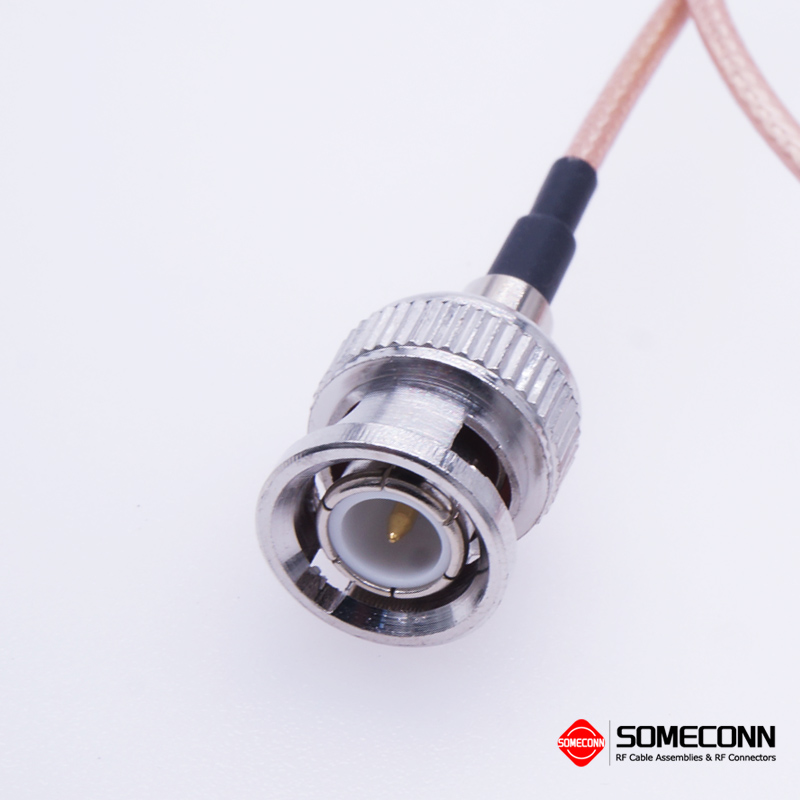
RG316 BNC Cable is a compact, flexible 50Ω coaxial cable assembly widely used in RF, microwave, communications, test & measurement, aerospace, military electronics, GPS, medical equipment, industrial electronics and other applications requiring reliable high-frequency signal transmission within confined spaces.
Compared with larger-diameter coaxial cables such as RG58, RG316 features a small outer diameter and good flexibility, making it ideal for compact electronic devices and applications with limited internal routing space.
RG316 typically adopts fluoropolymer insulation and jacket construction. With proper cable design, it delivers excellent temperature resistance and environmental adaptability.
When RG316 cable is terminated with BNC connectors on both ends, it forms an RG316 BNC Cable Assembly, which can be used to connect electronic test instruments, RF equipment, communication devices, antennas, test fixtures and other electronic equipment equipped with BNC interfaces.
However, selecting RG316 BNC Cable cannot be simply regarded as “RG316 cable plus a BNC connector”. Engineers and procurement specialists need to comprehensively consider:
Characteristic impedance
Operating frequency
Insertion loss
Cable length
Shielding construction
Connector type
Termination method
Operating temperature
Mechanical flexibility
Operating environment
This article provides a comprehensive overview of RG316 BNC Cable, including product construction, key specifications, application fields, differences between RG316 and RG174/RG58, BNC connector selection, advantages and limitations, OEM/ODM customization, manufacturing workflow, quality control and procurement considerations.
1. What is RG316 BNC Cable?
RG316 BNC Cable is an RF cable assembly built from RG316 coaxial cable, terminated with BNC connectors on one or both ends.
RG316 is normally designed as a 50 Ohm (50Ω) coaxial cable, compatible with a wide range of 50Ω RF and communication systems.
A typical RG316 BNC Cable mainly consists of:
Center conductor
Dielectric insulation layer
Shield layer
Outer jacket
BNC connector
Various connector combinations can be manufactured to meet different equipment and application requirements. Common product configurations:
BNC Male to BNC Male
BNC Male to BNC Female
BNC Female to BNC Female
BNC Male to SMA Male
BNC Male to SMA Female
BNC Male to TNC
BNC Male to N-Type
BNC combined with other RF connectors
Customization is available upon customer request for: Cable length, connector orientation, shielding construction, outer jacket, labeling, packaging and test requirements.
2. Why is RG316 Widely Adopted?
RG316 is popular in engineering applications because it achieves a good balance across multiple performance attributes:
Small outer diameter
Excellent flexibility
50Ω characteristic impedance
Good RF performance
High-temperature resistance with proper construction
Suitable for compact devices
Compatible with many types of RF connectors
More and more electronic devices pursue miniaturization. Thicker coaxial cables occupy more space and may complicate internal wiring. RG316 can solve this problem to a certain extent.
It is suitable for:
RF test instruments
Communication equipment
GPS devices
Avionics
Military electronics
Medical instruments
Industrial electronics
Wireless communication equipment
Laboratory instruments
3. Internal Construction of RG316 Cable
The electrical and mechanical performance of RG316 BNC Cable is closely related to its internal structure.
3.1 Center Conductor
The center conductor carries RF signals. RG316 generally uses copper-based conductors; some versions adopt silver-plated copper conductors.
Center conductor material affects:
Electrical conductivity
RF performance
Flexibility
Temperature performance
Mechanical reliability
For special engineering projects, refer to the conductor material specified in the product datasheet.
3.2 Dielectric Layer
The dielectric layer sits between the center conductor and shield layer. RG316 commonly uses fluoropolymer materials such as PTFE, which offer superior electrical and thermal properties.
The dielectric layer influences:
Characteristic impedance
Signal propagation
Capacitance
Attenuation
Temperature performance
Mechanical performance
During RG316 production, the dimensional relationship among center conductor, dielectric and shield must be precisely controlled, because the geometry of a coaxial cable directly determines impedance.
3.3 Shield Layer
The shield surrounds the dielectric layer, mainly to reduce the impact of external electromagnetic interference on RF signals.
Depending on cable construction, the following shielding options are available:
Silver-plated copper braid
Tinned copper braid
Copper braid
Foil + braid
Other custom shielding structures
If the cable is installed in high-EMI environments, select the proper shielding construction according to system requirements.
3.4 Outer Jacket
The outer jacket protects the internal structure and determines the cable’s environmental resistance. RG316 cables typically use fluoropolymer or other application-specific jacket materials.
The outer jacket affects:
Temperature resistance
Flexibility
Abrasion resistance
Chemical resistance
Environmental stability
For special applications, confirm the actual cable construction and jacket material with the manufacturer.
4. Typical Specifications of RG316 BNC Cable
Exact specifications of RG316 vary by manufacturer, materials and construction.
| Parameter | Typical Description |
| Cable Type | RG316 |
| Characteristic Impedance | 50Ω |
| Outer Diameter | Approx. 2.5–3 mm |
| Center Conductor | Copper-based / Silver-plated copper available per construction |
| Dielectric | PTFE or fluoropolymer |
| Shield | Braid / Custom construction |
| Outer Jacket | Fluoropolymer or other specialty materials |
| Connector | BNC or other RF connectors |
| Connector Gender | Male / Female |
| Cable Length | Customizable |
| Operating Frequency | Subject to specific construction |
| Attenuation | Dependent on frequency and cable construction |
| Temperature Performance | Subject to specific construction |
| Packaging | Bulk / Individual pack / OEM |
Important Note: The designation “RG316” alone does not guarantee identical performance across all products. Actual attenuation, temperature range, shielding effectiveness, voltage rating and mechanical performance are all determined by specific manufacturing construction. For engineering procurement, request the official datasheet from your supplier.
5. Major Applications of RG316 BNC Cable
RG316 BNC Cable is deployed in a broad range of RF and electronic equipment.
RF Test & Measurement
Test & measurement is a key application field for RG316 Cable Assemblies. Examples:
Signal generators
Spectrum analyzers
RF analyzers
Oscilloscopes
Network analyzers
RF test fixtures
Laboratory instruments
BNC connectors are widely used on test equipment to deliver fast and stable connections.
6. Avionics
RG316 is frequently used in electronics requiring compact size, flexibility and reliable temperature performance. Typical applications:
Avionics equipment
Navigation systems
Communication devices
Aircraft instruments
RF test systems
Avionics modules
For aerospace projects, verify cable temperature rating, materials, reliability, environmental testing, certifications and documentation requirements according to project specifications.
7. Military & Defense Electronics
RF Cable Assemblies are used in many electronic systems requiring stable signal interconnection. RG316 BNC Cable may be applied to:
Communication equipment
RF test systems
Radar-related equipment
Electronic instruments
Portable electronic devices
Defense communication equipment
Military or defense projects may impose extra requirements for environmental testing, product traceability, materials, reliability, qualification certifications and technical documentation. Select products in accordance with project specifications.
8. GPS & GNSS Systems
RG316 can be used for GPS and GNSS signal interconnection when its RF performance meets system requirements. Typical applications:
GPS receivers
GNSS devices
Navigation systems
Positioning equipment
GPS antennas
RF development systems
For GPS/GNSS applications, pay close attention to frequency, cable length, attenuation and connectors. These parameters directly affect final signal quality.
9. Medical Equipment
Certain medical and laboratory electronic devices adopt miniature RF cable assemblies. Possible applications:
Medical instruments
Detection equipment
Monitoring devices
Laboratory analytical equipment
Electronic measurement instruments
Medical applications usually impose stricter requirements on materials, cleanliness, reliability, product documentation and quality traceability, so customization is required to match specific equipment specifications.
10. Industrial Electronics
RG316 BNC Cable serves industrial electronic devices requiring compact RF interconnection. Applications:
Industrial monitoring
RF sensors
Automation equipment
Measuring devices
Control equipment
Electronic instruments
If the operating environment involves high temperature, vibration, humidity, chemical corrosion or mechanical abrasion, select the corresponding cable construction.
11. RG316 BNC Cable vs RG174 BNC Cable
RG316 and RG174 are both common small-diameter 50Ω coaxial cables, but differ in materials and performance.
| Characteristic | RG316 | RG174 |
| Impedance | 50Ω | 50Ω |
| Outer Diameter | Small | Small |
| Flexibility | Good | Good |
| Dielectric | Typically PTFE-based | Typically PE-based |
| Temperature Capability | Higher with proper construction | Generally lower |
| RF Applications | Wide range | Wide range |
| Compact Devices | Highly suitable | Highly suitable |
| Cost | Generally higher | Generally economical |
| Specialized Applications | More common | More for general-purpose use |
Choose RG174 if your priorities are cost, general RF connection and miniaturization. Choose RG316 if temperature resistance, specialty materials and professional RF performance are critical. Final selection shall be based on the actual product datasheet.
12. RG316 BNC Cable vs RG58 BNC Cable
RG316 and RG58 are both used in 50Ω systems, with obvious dimensional differences.
| Characteristic | RG316 | RG58 |
| Impedance | 50Ω | 50Ω |
| Outer Diameter | Small | Large |
| Weight | Light | Heavier |
| Flexibility | Good | Fair |
| Routing Space | Minimal | Larger |
| Attenuation | Construction-dependent | Construction-dependent |
| Temperature Performance | Good with proper construction | Construction-dependent |
| Mechanical Strength | Compact structure | Generally stronger |
| Long-Distance Transmission | Requires evaluation | Preferred for certain applications |
| Compact Devices | Highly suitable | Suitable |
RG316 fits devices with limited space requiring lightweight and flexible routing. RG58 excels in applications demanding higher mechanical strength, larger cable size or lower loss.
13. Connector Selection for RG316 BNC Cable and Cable Length
RG316 BNC Cable can be fitted with various BNC connectors.
BNC Male Primarily used to mate with BNC Female ports on equipment.
BNC Female Suitable for equipment interfaces and some panel-mount configurations.
Right Angle BNC Ideal for space-constrained equipment.
Bulkhead BNC Designed for panel or chassis feed-through mounting.
BNC to SMA One of the most popular RF cable assembly combinations, especially for connecting BNC test instruments and SMA-based RF modules.
BNC to TNC For systems using TNC interfaces.
BNC to N-Type Applicable for some communication, antenna and RF equipment.
Connector selection should consider: Equipment interface, available space, operating frequency, mounting method, environment and RF performance.
RG316 is available in multiple lengths. Common lengths: 0.3 m, 0.5 m, 1 m, 1.5 m, 2 m, 3 m, 5 m, plus other custom lengths.
For RF applications, cable length directly impacts signal loss. If low loss is critical for the system, minimize unnecessary cable length while reserving sufficient clearance for equipment installation and maintenance.
14. RG316 for High-Temperature Environments
A notable feature of RG316 is its fluoropolymer-based construction. Some RG316 constructions offer superior high-temperature performance compared with ordinary miniature PVC coaxial cables.
It can be considered for:
High-temperature electronic equipment
Electronics near heat sources
Aerospace systems
Industrial equipment
RF test fixtures
Laboratory instruments
Important reminder: The temperature rating cannot be judged merely by the name “RG316”. Actual thermal performance depends on dielectric, outer jacket, conductor, shield layer, connectors, termination method and overall construction. Confirm the operating temperature range of the specific product with the manufacturer before purchase.
15. Shielding Performance of RG316 BNC Cable
RF systems are usually sensitive to electromagnetic interference. Strong external EMI may distort RF signals, so shielding design of RG316 BNC Cable is critical.
Available shielding options:
Single braid
Silver-plated copper braid
Tinned copper braid
Foil + braid
Multi-layer shield
For cables installed near motors, switching power supplies, high-current conductors, inside industrial equipment or high-EMI environments, select a more robust shielding structure.
16. How to Select RG316 BNC Cable?
16.1 Confirm Impedance
RG316 is designed for 50Ω systems. First confirm whether your equipment requires 50Ω.
16.2 Confirm Frequency
Define the actual operating frequency range, since cable attenuation and RF performance are strongly frequency-dependent.
16.3 Confirm Length
Longer cables generally introduce higher signal loss.
16.4 Confirm Temperature
For high-temperature environments, verify cable temperature rating, connector temperature rating, termination process and service environment.
16.5 Confirm Connectors
Specify BNC Male/Female, Straight/Right Angle, plating, mounting method and interface dimensions.
16.6 Confirm Shielding
Select shielding construction according to EMI environment.
16.7 Confirm Flexibility
If the cable undergoes frequent bending, define flexibility requirements.
16.8 Confirm Operating Environment
Including temperature, humidity, vibration, chemical exposure, abrasion, outdoor conditions and mechanical stress.
17. RG316 BNC Cable Customization
Professional RF cable manufacturers can produce custom RG316 BNC Cable Assemblies per customer requirements.
Cable Length Customized to customer drawings or specifications.
Connector Combinations Examples: BNC-BNC, BNC-SMA, BNC-TNC, BNC-N, BNC paired with other connectors.
Connector Orientation Options: Straight, Right Angle.
Cable Construction Customizable items: conductor, dielectric, shield, outer jacket, flexibility, outer diameter.
Labelling Available options: Part Number, Serial Number, Barcode, Cable ID, Customer Logo.
Packaging OEM customers can customize individual packaging, bulk packaging, labels and custom packaging.
18. RG316 BNC Cable Manufacturing Process
Professional production of RG316 BNC Cable follows these steps:
Step 1: Raw Material Inspection Inspect RG316 cable, BNC connectors, SMA and other connectors, termination components.
Step 2: Cable Cutting Cut cable to specified length per order requirements.
Step 3: Precision Stripping Precisely strip outer jacket, shield layer, dielectric and center conductor to match connector requirements.
Step 4: Connector Preparation Prepare BNC and related termination parts.
Step 5: Termination Adopt crimping, soldering, compression termination or other validated processes based on connector design.
Step 6: Mechanical Inspection Check cable length, connector position, crimp quality, solder quality, outer jacket and connector appearance.
Step 7: Electrical Testing Perform tests upon customer request: continuity test, short-circuit test, insulation test, insertion loss, return loss, VSWR and RF performance tests.
19. Quality Control for RG316 BNC Cable
Quality control is essential for professional RF cable assemblies. A complete QC system includes:
Incoming Inspection Inspect cables, connectors and termination components.
In-Process Inspection Focus on stripped dimensions, termination dimensions, connector assembly, crimp quality and product consistency.
Final Inspection Check appearance, length, connector orientation, termination quality, continuity and RF performance.
Upon project request, suppliers can provide Inspection Report, Test Report, Product Drawing, Electrical Test Data and custom documentation.
20. RG316 BNC Cable OEM/ODM
RG316 BNC Cable is well suited for OEM and ODM projects. When standard off-the-shelf products cannot meet equipment requirements, custom production can be carried out according to customer product drawings, samples, part numbers, cable specs, connector specs and equipment interfaces.
Example: RG316 + BNC Male + SMA Male + 1m + Right Angle + customer label. The finished assembly can be directly installed into customer equipment.
For electronic equipment manufacturers, this reduces internal cable assembly work and improves consistency in mass production.
21. Key Advantages of RG316 BNC Cable
Compact Size: Suitable for miniaturized devices.
Good Flexibility: Facilitates internal equipment wiring.
50Ω Impedance: Compatible with many RF and communication systems.
Temperature Resistance: Properly constructed RG316 works in elevated temperature environments.
Wide RF Applications: Test, communications, GPS, aerospace, industrial electronics and instruments.
Rich Connector Options: Supports BNC, SMA, TNC, N-Type and other RF connectors.
Customizable: Length, connectors, shielding, labels and packaging can be customized.
22. Limitations of RG316 BNC Cable
Although RG316 has many strengths, it is not suitable for every application.
Cable Loss: Attenuation of small-diameter coaxial cables is generally higher than some large-diameter low-loss cables.
Power Handling: Miniature coaxial cables cannot support the same high power rating as large RF cables.
Mechanical Strength: Compact construction may require extra protection in high-mechanical-stress environments.
Cost: RG316 with specialty materials may cost more than general-purpose cables.
Therefore, RG316 selection shall be based on a comprehensive evaluation of frequency, length, power rating, temperature, environment and mechanical requirements.
26. RG316 BNC Cable Frequently Asked Questions (FAQ)
Is RG316 a 50Ω cable? Yes, RG316 is commonly used as a 50Ω coaxial cable. However, the final specifications shall be subject to the datasheet provided by the actual manufacturer.
Is RG316 better than RG174? These two cables feature different constructions and application characteristics. RG316 generally uses fluoropolymer insulation and delivers superior temperature performance with proper design; RG174 is more often used for cost-effective general RF interconnections. The final selection depends on the specific application requirements.
Can RG316 be used in high-temperature environments? Certain RG316 constructions are suitable for elevated-temperature environments, but the operating temperature range of the specific product must be verified.
Can RG316 be fitted with BNC connectors? Yes. RG316 BNC Cable Assemblies can be fabricated using compatible BNC connectors and proper termination processes.
Can RG316 BNC Cable be customized? Yes. Customizable options: / Length / Connectors / Connector orientation / Shielding / Labelling / Packaging / Test requirements
Can RG316 be used for GPS? Yes. RG316 is acceptable when operating frequency, attenuation, connectors and cable length meet the requirements of GPS/GNSS systems.
Can RG316 be used for aerospace equipment? RG316-type cables can be applied in certain electronic systems with requirements for compact size, temperature resistance and RF performance. However, specific aerospace projects may require additional qualification certifications and technical documentation.
Can RG316 be used outdoors? This depends on the actual jacket material, connector sealing design and service environment. For outdoor projects, select cable construction matching the real environmental requirements.
What are the differences between RG316 and RG58? RG316 has a noticeably smaller diameter, lighter weight and better flexibility. RG58 has a larger diameter and offers different attenuation, mechanical strength and power handling capacity in some applications.
28. Why Purchase Directly from RG316 BNC Cable Manufacturers?
For B2B customers, sourcing directly from RF Cable Assembly manufacturers brings supply-chain advantages.
Direct Factory Supply Customers can communicate directly with the manufacturer.
Customization Support Production can be carried out according to customer drawings and specifications.
Engineering Communication Technical issues can be discussed directly with the manufacturer’s engineering team.
Batch Consistency After product specifications are confirmed, subsequent orders can be produced under unified manufacturing standards.
OEM Support Available offerings: / Customer labels / Part Numbers / Packaging / Barcodes / Product technical documentation
For: / Distributors / Wholesalers / System Integrators / Electronics Manufacturers / Engineering Companies
Working directly with Cable Assembly Manufacturers reduces communication links and facilitates custom product development.
29. Summary
RG316 BNC Cable is a compact 50Ω coaxial cable assembly, primarily designed for electronic and RF systems requiring: Small form factor + Flexibility + RF performance + BNC connectivity + Temperature adaptability
It is widely applicable to:
RF test equipment / Communication devices / GPS/GNSS / Avionics / Military electronics / Medical equipment / Industrial electronics / Laboratory instruments / Wireless communication systems
One key feature of RG316 is its typical fluoropolymer-based construction. With proper product design, it provides excellent thermal and environmental performance.
Nevertheless, RG316 remains a small-diameter coaxial cable.
Therefore, key factors must be considered in practical applications:
Attenuation / Operating frequency / Cable length / Power rating / Temperature / Shielding / Mechanical environment
For OEM, ODM, Distributors, Wholesalers and engineering projects, RG316 BNC Cable Assemblies can be customized as requested:
Custom cable length / Custom BNC connectors / SMA/TNC/N-Type connector combinations / Straight / Right Angle / Custom shielding construction / Custom labelling / OEM packaging / Electrical performance testing
If you are searching for an RG316 BNC Cable Manufacturer / RG316 BNC Cable Supplier, please provide your: Cable length + connector model + quantity + application scenario + technical requirements
Professional RF cable manufacturers can confirm the suitable RG316 BNC Cable construction based on this information and provide corresponding quotations.