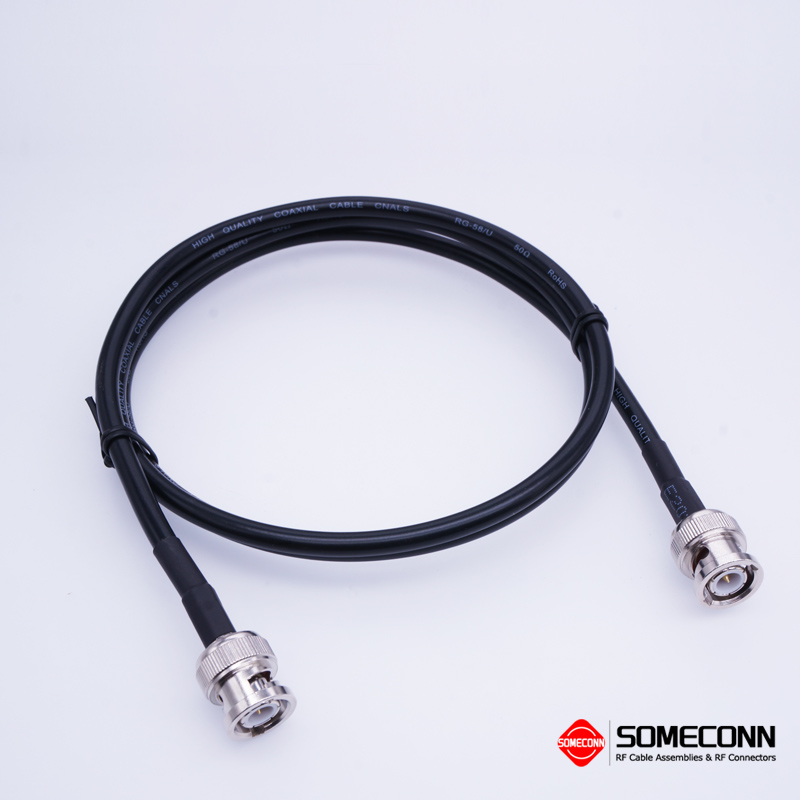
Introduction to RG58 BNC Cable
RG58 BNC cable is one of the most widely used coaxial cable assemblies in RF communications, wireless systems, test equipment, and industrial electronics. Combining the dependable performance of RG58 coaxial cable with the quick-locking capability of BNC connectors, it delivers low-loss RF signal transmission, excellent shielding, and stable impedance, making it a highly practical solution.
For decades, RG58 BNC cable assemblies have been used in military communication systems, laboratory test equipment, GPS devices, CCTV systems, amateur radio, antenna connections, and industrial automation equipment. With their flexibility, cost-effectiveness, and abundant supply, RG58 cables remain an important choice for engineers and purchasing professionals worldwide.
High-quality RG58 BNC cable assemblies deliver both stable signal transmission and mechanical durability, even under demanding conditions. Whether for short-distance RF connections or general communication systems, RG58 BNC cable remains the preferred choice of professionals.
This article provides a comprehensive overview of RG58 BNC cables, covering cable construction, specifications, electrical characteristics, applications, advantages and disadvantages, and key sourcing considerations.
What Is an RG58 BNC Cable?
An RG58 BNC cable is a coaxial cable assembly consisting of RG58 coaxial cable with a BNC (Bayonet Neill-Concelman) connector crimped to one or both ends.
The cable has a characteristic impedance of 50 ohms, making it suitable for a large number of RF communication and data transmission applications.
“RG58” denotes a family of coaxial cable originally developed to military specifications. Although the original military standard has been revised over time, RG58 has become a generic industry term for the flexible 50Ω coaxial cable commonly used in RF applications.
BNC connectors are compact, quick-connect RF connectors that use a bayonet locking mechanism, allowing users to connect and disconnect cables rapidly while maintaining reliable electrical contact.
A typical RG58 BNC cable assembly comprises:
RG58 coaxial cable
Center conductor
Dielectric insulation
Shielding
Outer protective jacket
BNC male or female connector
Connector termination accessories
RG58 cable combined with BNC connectors forms an extremely versatile RF cable assembly, typically suitable for frequencies up to a few gigahertz, depending on cable quality and connector design.
RG58 Cable Construction
Understanding the internal construction of RG58 cable helps in assessing its performance.
1. Center Conductor
The center conductor carries the RF signal. Common conductor materials: solid copper conductor. Solid copper offers:
Excellent conductivity
Stable impedance
Low signal resistance
Outstanding RF performance
Solid-copper RG58 cable is mostly used in permanent installations where signal reliability is the highest priority.
Stranded copper conductor. Characteristics of stranded copper conductors:
Greater flexibility
Withstands repeated bending
Easier routing in complex environments
Mostly used in test cables, mobile communication systems, and portable equipment.
2. Dielectric Insulation
The dielectric material separates the center conductor from the shield and keeps cable impedance at the correct value.
Common dielectric materials: polyethylene (PE). Advantages:
Excellent electrical insulation
Low moisture absorption
Good mechanical strength
Foamed polyethylene. Advantages:
Lower dielectric loss
Lower attenuation
Better high-frequency performance
Dielectric design directly affects the cable’s velocity factor, capacitance, and signal attenuation.
3. Shielding
The shield protects the RF signal from electromagnetic interference (EMI) and radio frequency interference (RFI).
Common shielding options for RG58: single-shield RG58. Construction: aluminum foil or copper braid. Characteristics:
Good value for money
Lightweight
Suitable for general applications
Double-shield RG58. Construction: aluminum foil shield + copper braid shield. Advantages:
Higher shielding effectiveness
Improved interference rejection
Better signal integrity
In industrial environments with strong electromagnetic interference, double-shielded RG58 BNC cable is preferred.
4. Outer Jacket
The outer jacket protects the cable from external environmental damage.
Common jacket materials: PVC (polyvinyl chloride) jacket. Advantages: good flexibility, low cost, suitable for indoor use.
PE (polyethylene) jacket. Advantages: better weather resistance, high mechanical durability, suitable for outdoor environments.
LSZH (low smoke zero halogen) jacket. Advantages: low emission of toxic smoke, suitable for rail transit and confined spaces.
Electrical Specifications of RG58 BNC Cable
RG58 BNC cable performance depends on several key electrical parameters.
Characteristic Impedance: 50 Ohms
Standard characteristic impedance of RG58 cable: 50Ω (within a certain tolerance).
Impedance matching between the cable, connector, antenna, and equipment is critical in order to avoid signal reflection. Impedance mismatch causes:
Higher VSWR (voltage standing wave ratio)
Greater signal loss
Reduced transmission efficiency
Degraded equipment performance
Frequency Range
The practical usable frequency depends on cable construction, quality, and length.
Typical RG58 applications:
VHF (very high frequency) communication
UHF (ultra high frequency) systems
GPS signals
RF test equipment
Wireless devices
For most RG58 cables, the typical upper operating limit is around:
1 GHz
2 GHz
High-quality versions maintain acceptable performance at higher frequencies.
Attenuation Characteristics
Attenuation refers to the signal loss that occurs as an RF signal travels through the cable.
Attenuation is affected by the following factors: cable length, operating frequency, conductor material, dielectric type, and shielding design.
| Frequency | Typical RG58 loss |
| 100 MHz | Low attenuation |
| 400 MHz | Moderate attenuation |
| 1 GHz | Higher attenuation |
For short-distance installations, RG58 offers excellent value for money; for long-distance RF transmission, lower-loss cables such as RG213 or the LMR series are recommended.
VSWR Performance
VSWR is used to measure how good the impedance match is.
A high-quality RG58 BNC cable assembly should achieve:
Low VSWR
Stable RF transmission
Reduced signal reflection
Factors affecting VSWR: connector quality, cable termination workmanship, impedance consistency, and mechanical stress. Professional manufacturers test finished cables for VSWR to ensure reliability in use.
Mechanical Characteristics of RG58 BNC Cable
Beyond electrical performance, mechanical reliability is equally important in industrial settings.
Main mechanical advantages: good flexibility. RG58 cable has a relatively small outer diameter and a flexible construction, making it easy to route. Typical outer diameter is approximately 4.5-5.0 mm. This makes it possible to achieve: a smaller bend radius, easier cable routing, and installation inside compact equipment.
Light weight. Compared with larger coaxial cables: lower installed weight, easier transport, and reduced installation difficulty.
Connector compatibility.
RG58 cable can be paired with many connector types:
BNC male
BNC female
SMA connector
TNC connector
Type N connector
MMCX connector
Custom combination connectors are also available for OEM projects.
Types of RG58 BNC Cable Assemblies
RG58 BNC cable is available in many configurations to meet different application requirements. The basic construction is broadly the same, but differences in conductor, shielding, jacket, connector, and length can significantly change cable performance. Understanding the different types enables engineers and buyers to select the most suitable product for a project.
1. Standard RG58 BNC Cable
The standard version is the most commonly used type for general RF signal transmission. Typical characteristics:
50-ohm impedance
Flexible PVC jacket
Copper conductor
Copper braid shielding
BNC male connectors on both ends
Common uses: RF test equipment, amateur radio, antenna connections, communication equipment, and laboratory instruments.
Standard RG58 cable balances cost, flexibility, and electrical performance. It is well stocked by distributors and suits the vast majority of general RF applications.
2. Low-Loss RG58 BNC Cable
Conventional RG58 has moderate attenuation compared with larger coaxial cables. Where higher signal performance is required, low-loss RG58 variants can be used.
Characteristics:
Optimized dielectric material
Higher-grade shielding
Lower conductor resistance
Reduced signal attenuation
Advantages: improved transmission efficiency, higher signal strength, and better performance at high frequencies.
Mostly used in wireless communication systems, GPS installations, RF monitoring systems, and antenna feeders.
3. High-Flex RG58 BNC Cable
The flexible version uses a stranded center conductor and offers excellent bending performance. Advantages: easy installation, good flexibility, withstands repeated movement, and resists mechanical stress.
Typical applications: portable RF test equipment, field communication equipment, mobile antenna systems, and laboratory measuring instruments. Suitable for environments where cables are frequently plugged, unplugged, and repositioned.
4. Outdoor RG58 BNC Cable
Cables used outdoors require extra protection against environmental exposure. Outdoor RG58 BNC cable is generally supplied with:
UV-resistant jacket
Waterproof construction
Reinforced sealing at the connectors
Weather-resistant materials
Applications: outdoor antennas, security systems, wireless communication links, and remote monitoring equipment. For outdoor installations, connector waterproofing and jacket quality directly determine long-term reliability.
5. Custom RG58 BNC Cable Assemblies
Many industrial customers do not use standard off-the-shelf products and need custom cable assemblies instead.
Customizable items: cable length. 0.5 m, 1 m, 2 m, 5 m, 10 m, or any custom length.
Connector pairing. BNC male to BNC male; BNC male to BNC female; BNC male to SMA male; BNC male to N male; BNC female bulkhead panel connector.
Cable jacket. PVC, PE, LSZH, and flexible rubber jackets.
Labels and packaging. OEM customers can have custom labels, part numbers, and barcode stickers; individual packaging or bulk packing.
Custom RG58 cable allows companies to integrate the cable directly into their own equipment and systems.
Main Applications of RG58 BNC Cable
Thanks to its reliability, flexibility, and cost-effectiveness, RG58 BNC cable is used across a great many industries.
1. RF Test Equipment
Laboratory testing is one of the primary applications of RG58 BNC cable. Compatible instruments: spectrum analyzers, signal generators, oscilloscopes, network analyzers, and various RF measurement devices.
Advantages in test settings: easy connect and disconnect, stable signals, compatibility with a large number of instruments, and low replacement cost. The bayonet locking mechanism of BNC connectors allows rapid assembly and disassembly while ensuring good electrical contact, which makes them very common in test equipment.
2. Wireless Communication Systems
Widely used in wireless communication: radio communication, walkie-talkies, base station connections, antenna systems, and RF modules. The 50-ohm impedance match meets the impedance matching requirements of RF communication systems.
3. Amateur Radio (Ham Radio)
Amateur radio operators have used RG58 cable extensively for decades. Typical uses: transceiver-to-antenna connections, short-distance antenna feeders, portable radios, and mobile radios. Advantages for hobbyists: affordable price, simple installation, ample supply, and compatibility with mainstream RF connectors. For short-distance antenna runs, RG58 is a popular choice.
4. GPS Navigation Systems
Some GPS devices use RG58 BNC cable: GPS antenna wiring, navigation equipment, timing systems, and satellite signal distribution. For applications with extremely strict loss requirements, dedicated low-loss cable is used; but for short-distance runs, RG58 is perfectly usable.
5. CCTV and Security Systems
Some analog video security devices use BNC connectors. Uses: camera wiring, video surveillance systems, and security equipment. Note: modern high-resolution surveillance systems are bandwidth-limited and require other cable solutions.
6. Industrial Automation
Industrial sites require stable signal connections. RG58 BNC cable can be used for equipment communication, industrial sensors, control devices, and automated test systems. Advantages: mechanical durability, simple maintenance, and stable RF connections.
7. Medical and Scientific Instruments
Many scientific instruments are equipped with BNC interfaces. Applications: measuring instruments, laboratory equipment, and signal monitoring systems. Stable electrical performance combined with simple connector operation makes them suitable for professional instruments.
RG58 vs. Other Coaxial Cables
Coaxial cable selection must take frequency, transmission distance, flexibility, and cost into account.
RG58 vs. RG174 BNC Cable
| Parameter | RG58 | RG174 |
| Impedance | 50 ohms | 50 ohms |
| Outer diameter | Larger | Smaller |
| Flexibility | Good | Excellent |
| Signal loss | Lower | Higher |
| Power handling | Higher | Lower |
| Installation space | Takes up more space | Takes up very little space |
RG58 advantages: better RF performance, higher power handling, and stronger mechanical construction. RG174 advantages: compact size, extremely flexible, and suitable for miniature devices. RG174 suits small electronic products; where RF performance matters, RG58 is the priority.
RG58 vs. RG213 BNC Cable
| Parameter | RG58 | RG213 |
| Outer diameter | Small | Large |
| Flexibility | High | Moderate |
| Attenuation | Relatively high | Relatively low |
| Power handling | Moderate | High |
| Installation difficulty | Simple | More complex |
RG58 advantages: light weight, good flexibility, and lower cost. RG213 advantages: low signal loss, good long-distance performance, and high power capacity. RG213 is mostly used for high-power communication; RG58 is better suited to short-distance connections.
RG58 vs. LMR195 / LMR240 Cable
The LMR series is a newer generation of low-loss RF cable with better performance.
| Parameter | RG58 | LMR series |
| Cost | Lower | Higher |
| Loss | Higher | Lower |
| Flexibility | Good | Good |
| Shielding effectiveness | Moderate | Excellent |
LMR is mostly used in professional wireless infrastructure; RG58 remains well suited to ordinary general-purpose applications.
Advantages of RG58 BNC Cable
Cost-effective: lower cost than various low-loss RF cables; replacement cost is manageable; market supply is abundant. For large-volume cable projects, the cost advantage is clear.
Easy to install: the cable is flexible and easy to route; the bend radius is small; connectors are easy to attach and detach.
Broad compatibility: works with RF instruments, communication equipment, antenna systems, and test equipment.
Reliable signal transmission: consistent impedance, good shielding effectiveness, reliable connector contact, and stable RF performance once properly matched and installed.
Ample supply: produced by many manufacturers worldwide, with numerous sourcing channels and fast delivery.
Limitations of RG58 BNC Cable
Higher signal loss than low-loss cables: attenuation is a notable problem over long distances; long-distance, very-high-frequency, or high signal-strength applications require a different cable.
Limited high-frequency performance: performance in the microwave band is average; microwave systems should prioritize semi-rigid coaxial cable or dedicated low-loss RF cable.
Moderate power handling: power capacity is limited compared with thicker coaxial cables; high-power transmitters generally use larger-gauge cable.
Key Points for Selecting RG58 BNC Cable
Confirm impedance requirements: RG58 is standard 50 ohms; always confirm that the equipment also requires 50-ohm impedance. Impedance mismatch causes signal reflection, degraded performance, and even equipment failure.
Determine cable length: the longer the cable, the greater the signal loss; choose the shortest usable length that still meets routing requirements.
Choose the correct connector: BNC male, BNC female, SMA, TNC, or Type N, based on the equipment interface.
Assess the operating environment: for harsh conditions, consider waterproof connectors, UV-resistant jackets, temperature-resistant materials, and enhanced shielding.
Check quality-related certificates and reports: reputable RF cable manufacturers can generally provide electrical test reports, VSWR reports, insertion loss test data, and material certificates to assure long-term stability.
RG58 BNC Cable Manufacturing Process
Producing reliable RG58 BNC cable assemblies requires strict control throughout the entire process. The cable looks simple, but professional production involves material selection, connector termination processes, precision engineering, and full electrical testing. Reputable manufacturers follow standardized processes to ensure that every cable meets RF performance requirements.
1. Raw Material Selection
The first production step is screening qualified raw materials. Copper conductor: this directly determines electrical performance. High-purity copper offers good conductivity, low signal resistance, stable transmission, and high mechanical reliability. Bare copper, tinned copper, stranded copper, and solid copper are available, selected according to the application.
Dielectric material: maintains the cable’s impedance characteristics. Common options include solid polyethylene (PE), foamed polyethylene, and low-loss dielectric materials. A uniform dielectric structure ensures stable capacitance, controllable impedance, and reduced signal attenuation.
Shielding material: shielding quality determines RF cable performance. Copper braid shielding: good flexibility, strong mechanical protection, and effective resistance to electromagnetic interference. Double shielding: aluminum foil layer + copper braid, for higher shielding effectiveness, better EMI suppression, and improved signal integrity.
Outer jacket material: protects the cable from external damage.
| Jacket material | Suitable applications |
| PVC (polyvinyl chloride) | Indoor use |
| PE (polyethylene) | Outdoor environments |
| LSZH (low smoke zero halogen) | Environments with special safety requirements |
| TPU (thermoplastic polyurethane) | Applications requiring high flexibility |
2.Cable Cutting and Preparation
Once raw materials have been inspected, RG58 cable is cut to customer specifications. The process includes: precise length measurement, stripping the outer jacket, arranging the shield, and exposing the center conductor. Stripping accuracy is critical; improper handling can damage the center conductor, the shield, or the dielectric insulation.
3. Connector Assembly
Connector processing directly determines cable reliability. Mainstream BNC termination methods: crimp termination: a crimping tool mechanically compresses the connector onto the cable. Advantages: fast production, reliable connection, and suitability for high-volume manufacturing.
Solder termination: the conductor and the connector contact are joined with solder. Advantages: excellent electrical connection, suitable for special custom applications.
Clamp termination: a mechanical structure clamps the cable. Advantages: high mechanical strength and good durability.
Professional manufacturers determine the termination method based on cable model, connector construction, application, and order volume.
4. Electrical Performance Testing
Testing is a critical step in production. Reputable factories generally perform the following tests:
Continuity testing: checks circuit continuity and identifies open circuits, short circuits, and poor contact.
Insulation testing: checks insulation performance between the conductor and the shield.
Insertion loss testing: measures cable signal loss and evaluates frequency response, attenuation, and transmission efficiency.
VSWR testing: evaluates impedance matching; a qualified cable has stable impedance, low reflection, and reliable RF transmission.
Shielding effectiveness testing: tests the cable’s ability to resist external interference, a key focus for industrial equipment, communications, and laboratory applications.
5. Final Inspection and Packaging
Appearance and mechanical inspection are completed before finished goods ship. Inspection items: connector appearance, cable length, label accuracy, packaging quality, and mechanical strength. Packaging options: individual plastic bags, PE bags, cartons, and custom OEM packaging.

RG58 BNC Cable FAQ
Q1: What is RG58 BNC cable used for? A: It is used for RF signal transmission, including test equipment, wireless communication, antenna connections, amateur radio, industrial electronics, and laboratory systems.
Q2: Is RG58 cable 50 ohms or 75 ohms? A: The vast majority of RG58 is 50-ohm coaxial cable intended for RF communication; 75-ohm types such as RG59 are mostly used in video and broadcast applications.
Q3: What is the maximum usable frequency of RG58 BNC cable? A: It depends on cable quality and construction; it is commonly used in VHF, UHF, and RF test and communication systems; for very high frequency applications, dedicated low-loss cable is recommended.
Q4: What is the maximum length of RG58 BNC cable? A: There is no fixed upper limit; performance depends on frequency, signal strength, allowable loss, and operating conditions. The higher the frequency, the more advisable it is to use a shorter cable.
Q5: Is RG58 better than RG174? A: Neither is absolutely better than the other. RG58 has lower loss, higher power handling, and stronger construction; RG174 has a smaller outer diameter and is more flexible, making it suitable for miniature devices. Selection depends on actual requirements.
Q6: Can RG58 BNC cable be used outdoors? A: Yes, provided that an outdoor-specific version is selected, with a UV-resistant jacket, weather-resistant construction, and waterproof connectors.
Q7: How do I choose a BNC connector for RG58 cable? A: Based on the equipment interface, installation environment, frequency, and mechanical conditions. Common options include BNC male, BNC female, right-angle BNC, and bulkhead BNC.
Q8: Is RG58 BNC cable available in custom versions? A: Yes. Length, connector type, jacket material, packaging, and labels can all be customized.
Why RG58 BNC Cable Remains an Important RF Solution
RG58 BNC cables have been widely used for such a long time because it balances performance, flexibility, supply, and cost.
Although newer generations of low-loss cable are already used in high-end communications, RG58 remains a very good fit for a great many scenarios, including RF testing, wireless communication, industrial electronics, antenna wiring, and laboratory instruments. 50-ohm impedance, flexible construction, reliable BNC interfaces, and ample global supply make it a highly practical solution for engineers, distributors, and OEM equipment manufacturers.
When sourcing RG58 BNC cable assemblies, companies should choose a professional manufacturer with sound quality control, customization capability, and export experience. A well-made RG58 BNC cable assembly delivers stable signal transmission, long service life, and reliable performance across every industry.