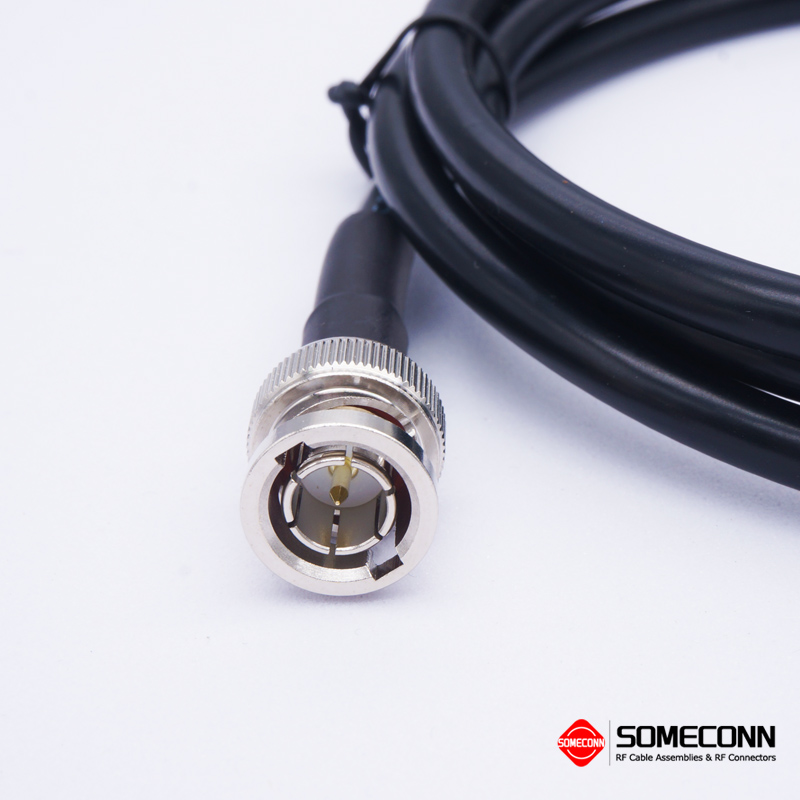
Introduction to RG59 BNC Cable
RG59 BNC cable is a coaxial cable assembly widely used for video, RF, CCTV surveillance, broadcasting, monitoring and other high-frequency signal transmission applications.
It combines RG59 coaxial cable with BNC connectors, delivering a reliable and convenient connection solution for electronic devices, cameras, monitors, test instruments and other signal transmission systems.
As a traditional coaxial cable, RG59 has been deployed in the electronics and telecommunications industries for many years. Thanks to its relatively small outer diameter, good flexibility, broad market availability and cost-effectiveness, RG59 is a common choice for many applications requiring medium transmission distances and dependable signal delivery.
A typical RG59 BNC cable consists of RG59 coaxial cable fitted with one or two BNC connectors. Depending on practical application requirements, it can be configured with BNC male, BNC female, right-angle BNC, feed-through BNC or other custom connector combinations.
One of the most critical characteristics of RG59 cable is its nominal 75-ohm characteristic impedance. For this reason, RG59 is particularly suitable for video and broadcasting applications, as these systems largely adopt 75-ohm signal transmission architectures.
Nevertheless, not all RG59 cables are identical.
The conductor material, dielectric construction, shielding type, outer jacket material, connector quality and manufacturing process all affect the performance of the finished RG59 BNC cable assembly.
This article presents a comprehensive overview of RG59 BNC cable, covering its definition, internal construction, major applications, differences from RG58, selection criteria, quality inspection, and key considerations when selecting an RG59 BNC cable manufacturer.
What Is RG59 BNC Cable?
RG59 BNC cable is a cable assembly fabricated by terminating RG59 coaxial cable with BNC connectors.
RG59 cable itself generally comprises four primary components:
Center conductor
Dielectric insulation layer
Metallic shield
Outer jacket
BNC connectors are mounted onto both ends of the cable via crimping, soldering or compression termination methods.
BNC connectors feature a bayonet locking mechanism. Unlike certain connectors that require multiple full rotations to secure, BNC connectors are locked by inserting and twisting.
This design makes BNC cable assemblies ideal for applications where cables are frequently installed, removed or replaced.
RG59 is associated with 75-ohm coaxial systems, making it well suited for video and broadcast signal transmission.
Common Applications of RG59 BNC Cable
CCTV surveillance systems
Analog surveillance systems
Professional video equipment
Broadcasting equipment
Video monitoring systems
Test and measurement instruments
RF signal transmission
Laboratory equipment
Industrial monitoring systems
Security systems
Understanding 75-Ohm RG59 Cable
Characteristic impedance stands as one of the most important technical parameters of RG59.
RG59 is engineered for a nominal characteristic impedance of 75 ohms.
Characteristic impedance is a key parameter describing the electrical behaviour of a cable during high-frequency signal transmission.
For stable operation of a transmission system, proper impedance matching must be maintained between the signal source, cable, connectors and receiving equipment.
For example, a typical video system may follow this chain: 75-ohm device → 75-ohm cable → 75-ohm connector → 75-ohm device
Maintaining correct impedance matching helps reduce signal reflection and ensures stable signal transmission.
This is also a major distinction between RG59 and many RG58 cables.
RG58 is commonly used in 50-ohm RF systems, while RG59 is designed primarily for 75-ohm video and broadcast systems.
Construction of RG59 BNC Cable
The performance of RG59 BNC cable depends heavily on its internal structure.
1. Center Conductor
The center conductor carries the primary electrical signal.
Common conductor materials include:
Bare copper
Copper-clad steel (CCS)
Tinned copper
Stranded copper
Different conductor materials vary in conductivity, mechanical strength, cost and flexibility.
Bare Copper Conductor Bare copper offers excellent conductivity and is widely used in applications demanding high signal performance. Main advantages:
High electrical conductivity
Low resistance
Superior signal transmission performance
Good solderability
Copper-Clad Steel Conductor Copper-clad steel features a steel core coated with a copper layer. Advantages:
High mechanical strength
Lower material cost
Suitable for certain long-distance cable constructions
The conductor material should be selected according to application and performance requirements.
2. Dielectric Insulation Layer
The dielectric sits between the center conductor and shield.
Common dielectric materials are polyethylene (PE) and foamed polyethylene.
The dielectric material impacts multiple critical cable parameters:
Characteristic impedance
Capacitance
Velocity of propagation
Signal attenuation
Mechanical stability
Consistent dielectric dimensions must be maintained during high-quality production, as variations in cable geometry can degrade impedance performance.
3. Shield Layer
The shield surrounds the dielectric and protects the internal signal from external electromagnetic interference (EMI).
Common shielding constructions:
Copper braid shield
Aluminum foil shield
Aluminum foil + braid shield
Multi-layer shield
Basic RG59 cables may use a single braid shield, whereas high-performance versions adopt a dual shield combining foil and braid.
In environments with strong electromagnetic interference, dual-shield RG59 cables deliver improved noise immunity.
Shielding performance is especially important for:
Industrial installations
Video surveillance
Broadcasting systems
Professional test systems
4. Outer Jacket
The outer jacket protects the cable’s internal components from mechanical damage and environmental exposure.
Common jacket materials:
PVC
PE
LSZH (Low Smoke Zero Halogen)
TPU
PVC is widely used for its balanced flexibility, durability and cost.
Outdoor RG59 cables may require UV-resistant, weather-rated jacket materials.
LSZH materials can be specified for applications with strict fire safety and low-smoke emission requirements.
Common Types of BNC Connectors for RG59 Cable
BNC connectors are one of the most visible components of RG59 BNC cable assemblies. Multiple BNC connector designs are available on the market.
BNC Male Connector
BNC male connectors are widely used for inter-equipment connections. Typical applications:
CCTV equipment
Monitors
Test instruments
Video equipment
BNC Female Connector
BNC female connectors are normally used as equipment or panel-mount interfaces. May be installed on:
Control panels
Test instruments
Electronic devices
Communication equipment
Right-Angle BNC Connector
Right-angle BNC connectors change the cable exit direction. Suitable for:
Space-restricted installations
Constrained cable routing
Wall-mounted equipment
Cases where straight connectors would cause excessive cable bending
Feed-through BNC Connector
Feed-through BNC connectors are designed for panel mounting. Commonly used on:
Equipment enclosures
Control panels
Laboratory instruments
Custom electronic devices
Main Specifications of RG59 BNC Cable
Exact specifications vary by manufacturer and cable construction. Typical characteristics are listed below:
| Parameter | Typical RG59 Properties |
| Cable Type | RG59 coaxial cable |
| Characteristic Impedance | 75 Ohm |
| Outer Diameter | Approx. 6 mm |
| Conductor | Copper or copper-based conductor |
| Dielectric | PE or foamed PE |
| Shield | Copper braid, aluminum foil or dual shield |
| Outer Jacket | PVC, PE, LSZH or custom |
| Connector | BNC or custom connectors |
| Application | Video, CCTV, RF, broadcasting |
| Cable Length | Customizable |
Note: Performance can differ significantly between RG59 constructions. Refer to the manufacturer’s official datasheet for definitive electrical specifications.
RG59 BNC Cable in CCTV Systems
CCTV surveillance represents one of the most prevalent applications for RG59 BNC cable.
Traditional analog CCTV systems use coaxial cables to transmit video signals between cameras and recording/monitoring hardware.
RG59 BNC cable assemblies enable this connection chain: CCTV Camera → RG59 Cable → BNC Connector → DVR
This topology features simple construction and reliable signal transmission.
RG59 has remained popular in CCTV systems for these key reasons:
Impedance characteristics optimized for video systems
Good signal transmission performance
Reasonable flexibility
Convenient BNC connection
Wide market availability
Competitive cost
For professional surveillance projects, cable quality and connector termination quality are critical.
Poor shielding or defective connector termination may lead to:
Image noise
Electromagnetic interference
Signal attenuation
Unstable contact
Selecting professionally manufactured RG59 BNC cable is essential for long-term stable operation of surveillance systems.
RG59 BNC Cable for Video Transmission
RG59 has a close association with video transmission.
Typical applications:
CCTV
Security cameras
Video monitors
Video distribution systems
Broadcasting equipment
Professional AV equipment
Its 75-ohm impedance makes RG59 suitable for many video systems.
Nevertheless, actual performance depends on:
Signal type
Frequency
Cable length
Shielding construction
Equipment requirements
For long-distance transmission or high-bandwidth applications, alternative cable solutions should be evaluated based on real requirements.
RG59 BNC Cable in Broadcasting
Broadcasting and professional video equipment typically operate on 75-ohm signal systems.
BNC connectors are widely adopted for:
Reliable mechanical connection
Fast installation
Stable electrical contact
Compact footprint
RG59 BNC cables can be deployed for certain broadcast and video signal interconnections, especially where transmission distance and bandwidth fall within the cable’s capability limits.
For high-end professional broadcast systems, engineers may select specially engineered 75-ohm coaxial cables to achieve higher bandwidth and lower attenuation.
RG59 BNC Cable in Test & Measurement
BNC connectors are ubiquitous on electronic test equipment.
Examples:
Oscilloscopes
Signal generators
Frequency counters
Pulse generators
Laboratory instruments
Monitoring equipment
RG59 BNC cables are used for signal connections requiring 75-ohm impedance.
Cable selection must match the impedance and frequency requirements of the instrument.
For instance, if test equipment is designed for a 50-ohm RF system, 50-ohm cables such as RG58 are more appropriate than 75-ohm RG59.
This is an important consideration when choosing RG59 BNC cable.
RG59 vs RG58 BNC Cable
RG59 and RG58 are often confused, as both are coaxial cables that can be fitted with BNC connectors. However, they are engineered for different applications.
| Characteristic | RG59 | RG58 |
| Nominal Impedance | 75 Ohm | 50 Ohm |
| Primary Applications | Video, CCTV | RF / Communications |
| CCTV Use | Common | Less common |
| RF Communications | Application-dependent | Common |
| Outer Diameter | Generally larger | Generally smaller |
| Typical Use Case | Video / Broadcast | RF / Radio |
| BNC Compatibility | Yes | Yes |
The most fundamental difference is impedance.
RG59 Typically used for:
Video
CCTV
Broadcasting
75-ohm signal systems
RG58 Typically used for:
RF communications
Radio systems
Antenna connections
50-ohm test systems
Therefore, when choosing between RG59 and RG58, the first step is confirming the impedance requirement of your equipment.
RG59 vs RG6 Cable
RG59 and RG6 are both widely available coaxial cables. RG6 features a larger outer diameter and is preferred for applications requiring lower attenuation or longer transmission distances.
| Characteristic | RG59 | RG6 |
| Outer Diameter | Smaller | Larger |
| Flexibility | Generally better | Generally lower |
| Nominal Impedance | 75 Ohm | 75 Ohm |
| Video Applications | Yes | Yes |
| Installation Difficulty | Lower | Higher |
| Long-Distance Performance | Moderate | Generally superior |
RG59 is better suited for applications requiring high flexibility and compact routing. RG6 is preferred for long-haul transmission and applications with strict low-attenuation requirements.
Key Advantages of RG59 BNC Cable
1. Compatible with 75-ohm systems RG59’s 75-ohm design fits a wide range of video and broadcast applications.
2. Flexible installation Compared with thicker coaxial cables, RG59 bends and routes easily. Suitable for:
Equipment racks
CCTV systems
Control panels
Indoor installations
3. Convenient BNC connection BNC connectors are simple to install. The bayonet design enables quick connection and locking, ideal for frequent plug-and-unplug scenarios.
4. Wide application coverage RG59 BNC cables serve multiple industries:
Security
Video
Broadcasting
Industrial monitoring
Test equipment
5. Cost benefit RG59 is widely stocked and provides an economical solution for many video and signal transmission systems. For large projects requiring hundreds or thousands of cable assemblies, unit costs can be further reduced via mass production by specialized factories.
Limitations of RG59 BNC Cable
Despite its many strengths, RG59 is not suitable for every application.
1. Signal Attenuation All coaxial cables incur signal loss as transmission distance and operating frequency increase. For long-distance applications, carefully evaluate:
Cable attenuation
Operating frequency
Required signal quality
Transmission distance
Long-haul scenarios may require thicker or low-loss coaxial cables.
2. Not suitable for all high-power RF systems RG59 is mainly intended for video and general signal transmission, not high-power RF delivery. High-power applications normally call for larger, specially designed coaxial cables.
3. Impedance matching must be observed Since RG59 is nominally 75-ohm, it cannot be used as a direct replacement for 50-ohm cables. Mismatched impedance may cause:
Signal reflection
Degraded signal quality
Reduced system performance
How to Select the Right RG59 BNC Cable
When purchasing RG59 BNC cable assemblies, focus on the following factors.
1. Confirm impedance requirement First verify your equipment specification: 50 Ohm or 75 Ohm. Standard RG59 applications use 75 Ohm.
2. Determine cable length Cable length directly affects signal attenuation.
Short cables: lower total loss, easier installation
Long cables: higher attenuation, stricter cable quality requirements
For very long cables, compare attenuation values at your actual operating frequency.
3. Select correct connectors Common options: BNC male, BNC female, right-angle BNC, feed-through BNC. Connectors must match the device interfaces.
4. Consider shielding construction For environments with heavy electromagnetic interference, select an appropriate shield type: Single braid, foil + braid, dual shield, high-coverage braid shield.
5. Consider installation environment Indoor deployments typically use standard PVC jackets. Outdoor applications may require: UV resistance, moisture resistance, weather-resistant materials.
Industrial applications may demand superior: Temperature tolerance, mechanical strength, flexibility.
Custom RG59 BNC Cable Assemblies
Professional cable manufacturers can produce custom RG59 BNC cable assemblies per customer requirements.
Customizable items: Cable Length Examples: 0.5 m, 1 m, 2 m, 3 m, 5 m, 10 m and other custom lengths.
Connector Combinations Examples: BNC male to BNC male BNC male to BNC female BNC female to BNC female BNC to SMA BNC to TNC BNC to Type N
Cable Construction Customers may specify: Conductor material, shielding construction, jacket material, outer diameter, flexibility requirements.
Labelling OEM cable assemblies can be fitted with: Customer part numbers, barcode labels, cable identification tags, printed logos.
RG59 BNC Cable Manufacturing Process
Professional RG59 BNC cable manufacturers maintain controls across the full production workflow.
1. Cable Cutting Precision equipment cuts cable to customer-specified lengths.
2. Cable Stripping Outer jacket and shield are stripped per process specifications without damaging the center conductor.
3. Connector Preparation BNC connectors and components are prepared according to the termination method.
4. Connector Termination Cable is assembled to BNC connectors using suitable methods: crimping, soldering, compression termination.
5. Mechanical Inspection Finished goods inspection: connector mounting, cable length, appearance, mechanical reliability.
6. Electrical Testing Tests can be performed as requested: Continuity test, short circuit test, insulation resistance test, insertion loss test, return loss test, VSWR test, impedance test.
Testing identifies defective units before shipment.
Quality Control for RG59 BNC Cable
Reliable cable assembly manufacturers implement comprehensive quality management systems.
Major QC stages: Incoming Material Inspection Raw materials are inspected before production: Cable specifications, connector dimensions, conductor quality, shielding materials, jacket materials.
In-Process Inspection Cable assemblies are checked during production. Potential defects detected: Incorrect strip length, damaged conductor, poor crimping, misassembled connectors.
Final Inspection Final check before shipment: Cable length, connector appearance, continuity, mechanical strength, electrical performance.
Benefits of Direct Sourcing from RG59 BNC Cable Manufacturers
Distributors, importers, system integrators and OEM customers can gain multiple advantages by purchasing directly from manufacturers.
Factory pricing: fewer supply chain intermediates reduce procurement costs.
Custom production: factories build cable assemblies to your exact specifications.
Consistent product quality: long-term cooperation stabilizes product specifications and quality.
Accelerated product development: manufacturers with engineering capacity support cable selection, connector selection, sample development and product optimization.
OEM packaging: products can be packed to customer requirements: individual packs, bulk packs, retail packaging, custom cartons.
RG59 BNC Cable for OEM & ODM Projects
OEM customers often require more than generic cables. For example, an equipment manufacturer may need: Specific cable length, specified BNC connectors, special jacket material, custom labels, special packaging.
Professional manufacturers can integrate all these requirements into a unified production specification. For high-volume projects, manufacturers maintain consistency in: Cable dimensions, electrical properties, connector configuration, packaging, part numbers.
This is especially important when RG59 BNC cables are supplied as accessory components for larger finished equipment.
Industry Applications of RG59 BNC Cable
Security & Surveillance: RG59 BNC cables have long been widely deployed in analog CCTV systems.
Broadcasting: 75-ohm coaxial systems are standard in professional video environments.
Test & Measurement: BNC interfaces are common on laboratory and electronic test equipment.
Industrial Monitoring: RG59 assemblies support industrial video and signal applications within their performance limits.
Professional AV: Many professional video and audio-video systems adopt BNC interfaces.
Scientific Instruments: BNC interfaces appear on a wide variety of laboratory and research devices.
RG59 BNC Cable FAQ
Is RG59 BNC cable 50 Ohm or 75 Ohm?
It is nominally a 75 ohm BNC cable. Always verify the exact product specification from the manufacturer before purchase.
What is RG59 BNC cable mainly used for?
Typical applications: CCTV, video transmission, broadcasting, monitoring, test equipment, industrial electronics.
Can RG59 be used for CCTV?
Yes. RG59 has been extensively used for analog CCTV and video signal transmission, especially for systems using BNC connectors.
What is the difference between RG59 and RG58?
The primary differences are impedance and application. RG59 is typically 75 Ohm for video; RG58 is typically 50 Ohm for RF communications.
Can RG59 BNC cable be custom-made?
Yes. Subject to manufacturer capacity, customization includes cable length, connector combinations, jacket material, shielding structure, labels and packaging.
Can RG59 BNC cable be used outdoors?
Outdoor-rated RG59 cable assemblies are available. Outdoor versions should feature UV-resistant jackets, weatherproof materials and waterproof connectors.
What BNC connectors work with RG59?
Depending on cable construction and application: BNC male, BNC female, right-angle BNC, feed-through BNC, waterproof BNC.
What is the maximum length for RG59 BNC cable?
There is no universal maximum length applicable to all scenarios. The feasible length depends on signal frequency, cable attenuation, source strength, receiver sensitivity and required signal quality. For long cable runs, review attenuation data at your operating frequency.
Is RG59 suitable for high-frequency applications?
RG59 supports many signal transmission applications, but usable frequency depends on cable construction. For high-frequency use, focus on attenuation, return loss, VSWR, shielding performance and connector specifications.
RG59 BNC Cable Manufacturers & Suppliers
For enterprises requiring stable quality and continuous supply, selecting a reliable RG59 BNC cable manufacturer is critical.
Qualified suppliers should offer: RG59 coaxial cable, RG59 BNC cable assemblies, custom cable lengths, custom BNC connectors, OEM service, ODM service, electrical testing, quality inspection, custom packaging.
Before inquiry, customers are advised to provide detailed technical requirements as fully as possible, including: Cable model, characteristic impedance, cable length, connector type/gender, cable jacket, shielding requirements, working environment, order quantity, test requirements.
Supplied details help manufacturers confirm technical feasibility and provide accurate quotations quickly.
How to Send an RFQ to an RG59 BNC Cable Supplier
When contacting RG59 BNC cable suppliers, a clear RFQ improves communication efficiency significantly.
Sample RFQ template:
Product: RG59 BNC Cable Assembly Impedance: 75 Ohm Cable Length: Custom Connector A: BNC Male Connector B: BNC Male Cable Jacket: PVC Shield: Foil + Braid Quantity: [Required Quantity] Application: CCTV / Video / RF / Industrial Packaging: Individual pack or bulk
Manufacturers will review this information to confirm technical feasibility, unit price, MOQ, sample availability, lead time and shipping options.
Conclusion
RG59 BNC cable remains an important coaxial cable solution for video, CCTV, broadcasting, monitoring, test and other 75-ohm signal transmission applications.
It combines the familiar 75-ohm coaxial construction with easy-to-use BNC connectors to simplify installation and maintenance.
Key factors for RG59 BNC cable selection: Characteristic impedance, cable construction, conductor material, shielding structure, cable length, operating frequency, connector quality, operating environment, manufacturing workmanship.
For standard indoor video and signal transmission applications, off-the-shelf RG59 BNC cable generally delivers an economical and reliable solution.
Higher-demand applications may require: Enhanced shielding, low-loss construction, special jackets, high-quality connectors and stricter electrical testing.
Professional RG59 BNC cable manufacturers can deliver custom cable assemblies matching your electrical, mechanical, environmental and packaging requirements.
Whether you are a distributor sourcing standard RG59 BNC cables, an importer placing bulk orders, an equipment developer building OEM products, or an engineering firm needing custom RF cable assemblies, selecting the correct cable design and dependable manufacturing partner is essential.
With proper cable selection, professional connector termination and rigorous quality control, RG59 BNC cable assemblies deliver stable, consistent signal connections across a wide range of professional applications.
Looking for a custom RG59 BNC cable manufacturer? We supply custom RG59 BNC cable assemblies, coaxial cable assemblies and OEM RF cable solutions for distributors, system integrators, equipment manufacturers and industrial customers.
Please share your requirements: Cable specifications, connector configuration, cable length, order quantity and application scenario.
Our engineering and sales team will provide product proposals and quotations according to your specific needs.
Contact us now for a quotation on your RG59 BNC Cable project.